Positioning before pipeline: the offer test we run before any outbound
When a campaign underperforms, everyone blames the copy. The copy is rarely the problem. Four questions, answered in an hour, predict most of the result before a single email goes out.

A campaign underperforms and the post-mortem starts in the same place every time. The subject lines were weak. The follow-up was too slow. We should test a different opener. Teams rewrite copy for three weeks and land back at a 1 percent reply rate, because the copy was doing its job. What it carried was empty.
Before we let any outbound programme start, the client answers four questions in writing. It takes about an hour with the person who closes deals. In our experience the answers predict the result of the campaign more reliably than anything we do afterwards with sequences and send volume.
Question 1: Who signs, by function
The usual answer is a company size and a sector. Mid-market manufacturers in the DACH region. That describes an account, and accounts do not read email. Name the human: the function, the seniority, and whether that person controls the budget line your invoice would land on.
The test is specific. Say the job title out loud, then say what that person is measured on this quarter. If you cannot state their metric, you are writing to a role you have not met. An operations director measured on unplanned downtime hears a different sentence from a CFO measured on working capital, even when they buy the identical product.
Where a purchase needs two functions to agree, pick the one whose problem is louder and write to them. Trying to satisfy both in a first email produces a paragraph that neither recognises.
Question 2: What breaks without you
Describe the buyer's situation with your product removed, in their units and their vocabulary. Not the benefit you deliver. The mess that persists in your absence.
Strong answers sound like this: their commercial team spends nine hours a week rebuilding the same report by hand; they turn away one order a month because they cannot certify the ingredient; the German subsidiary files two months late because nobody there reads the local tax notices. Each of those has a number in it and a person who feels it on a Tuesday.
Weak answers sound like this: they lack visibility; their processes are inefficient; they are not maximising their potential. Those describe every company on earth, which is why every company on earth ignores them.
If the sentence would still be true after you deleted your industry and pasted in another one, it is not a problem statement. It is filler.
Question 3: Why you, and what proves it
Buyers discount claims from strangers to roughly zero, which is rational of them. The question is what survives that discount. Three things do: a named customer they recognise, a number you can source, and a sample of the work itself.
Rank what you have. A client logo the buyer knows beats a percentage. A percentage with a named source beats an adjective. A piece of the actual work, twenty seconds of screen recording, a page of the audit, three of the leads you would have found for them, beats everything, because it moves the conversation from claim to evidence.
If the honest answer to question three is that you have no proof yet, that is workable. Say so and change the ask. Early-stage teams close their first customers by offering a small, bounded piece of work at low risk, then borrow that result as proof for the next twenty conversations. The failure mode is claiming proof you cannot show, which the buyer detects in one reply.
Question 4: Why this week
The most common outcome of a good first meeting in B2B is nothing. The buyer agrees the problem is real, the timing is wrong, and the thread dies in the follow-up folder. Urgency has to come from the buyer's calendar rather than your quarter.
Legitimate sources of now: a regulatory date that applies to them, a contract renewal you can see, a hiring gap they are visibly trying to fill, a season that decides their volume, a new site or listing they have committed to. Each of those existed before your email and will still be true if you never send it. That is what makes it credible.
Manufactured urgency does the opposite. Discounts that expire on Friday and slots that are filling up mark you as a vendor working a quota, and senior buyers price that in.
Score it before you spend
Give each answer a mark. Two points when it is specific and evidenced, one point when it is directional, zero when it is a placeholder.
| Total | Reading | Do this next |
|---|---|---|
| 7 to 8 | The offer stands on its own | Build the list and send |
| 5 to 6 | One weak leg, usually proof | Send at low volume, fix the leg in parallel |
| Under 5 | The campaign will not diagnose itself | Ten customer conversations first |
Under five, a campaign wastes more than money. It burns the domain reputation and the list, and it returns no usable signal, because you cannot tell which of the four legs failed. Ten conversations with real buyers cost a week and answer all four questions at once.
The argument test
One last check before the first send. Put the four answers in front of five people who resemble your buyer and watch which sentence they push back on. Agreement teaches you nothing. The sentence they argue with is either the one that is wrong or the one that is interesting, and both outcomes are worth the hour.
When the answers hold, copy becomes a formality. The first email writes itself out of question two and question four, the proof from question three goes in the second paragraph, and the whole thing takes twenty minutes. That is the version worth testing subject lines on.
We run this test before we run your campaign
Ripe Leads is KoFi Tech's outbound arm. Week one is the offer test, the signal and the list. Sending starts once the four answers hold, which is why the campaigns we do run produce a readable result instead of a shrug.
See how Ripe Leads worksRead next
-

Choosing your first EU market: a scoring model instead of a hunch
Founders pick Germany because it is big, or the Netherlands because everyone speaks English. Six weighted criteria, scored honestly, beat both instincts.
-
What a cold outbound pipeline actually costs in Europe
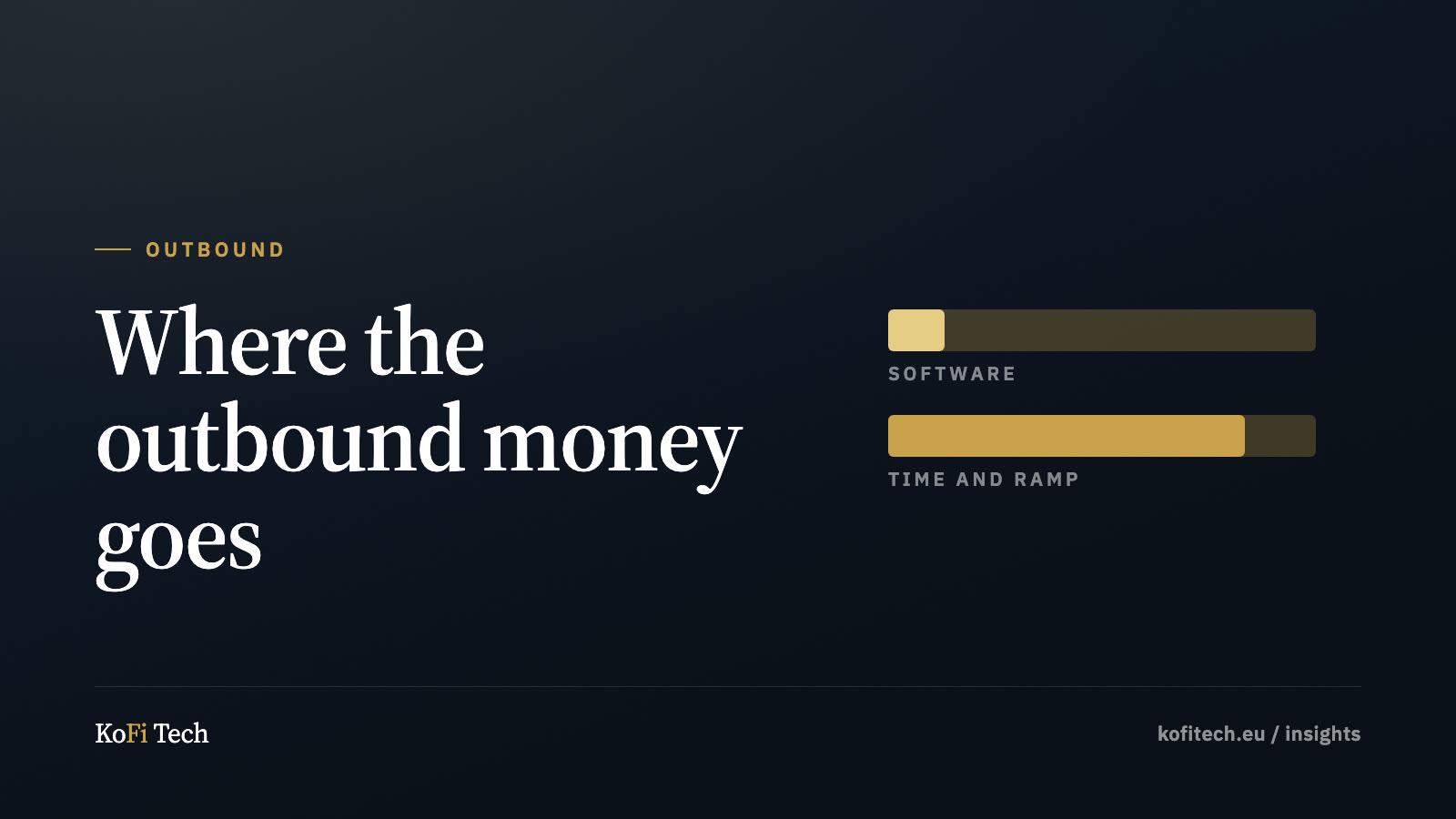
The software bill is the small number. Two hundred euros a month buys the sending infrastructure. The real cost sits in data, warm-up time and the six weeks before the first reply.

