Outbound agency or your first SDR: the arithmetic, then the part it misses
An in-house SDR in a mid-cost EU market costs €55,000 to €97,000 in year one. The decision is not about that number. It turns on whether the offer is proven and who will manage the role.

The question arrives in the same shape every time. We are entering Europe, we need meetings, do we hire an SDR or hire an agency? The honest answer depends on three things that have nothing to do with price: whether your offer is proven, whether you have a manager for the role, and whether you need the capability to still exist in two years.
Here is the arithmetic, then the part the arithmetic misses.
What an in-house SDR costs in Europe
Take a mid-level SDR in a mid-cost European market. Poland, Portugal, Lithuania and Spain all sit in a similar band for this role.
| Line | Year one | Note |
|---|---|---|
| Base salary | €28,000 to €42,000 | Higher in DACH, Nordics, Netherlands |
| Employer contributions | €6,000 to €13,000 | Varies from about 21% to 32% by country |
| Variable on meetings booked | €6,000 to €12,000 | Paid whether or not the meetings convert |
| Tooling and data | €3,000 to €6,000 | Sending platform, data credits, verification, CRM seat |
| Recruitment | €4,000 to €9,000 | Agency fee or three months of somebody's time |
| Management time | €8,000 to €15,000 | Roughly a day a week from someone senior |
Call it €55,000 to €97,000 for the first year, and the middle of that range is realistic for most companies. Divide by the meetings a competent SDR books in a market they are learning, which is 8 to 15 a month once ramped, and you land between €330 and €700 per meeting in year one.
Year two is cheaper. Recruitment drops out, ramp is done, and the same person books more. That is the case for hiring: the cost curve bends downward and the knowledge stays in the building.
Ramp is the number people forget
A new SDR in a new market produces very little for the first quarter. They are learning the product, the buyer, the objections, and in a cross-border launch they are learning a market nobody in the company knows either. Four to six months to full productivity is the range we see, and that assumes somebody experienced is coaching them.
If nobody in your company has run outbound before, the ramp does not end at six months. It ends when the SDR has taught themselves by trial and error, which takes longer and costs a domain reputation along the way.
Hiring your first SDR before you have a sales manager who has run outbound is the most common expensive mistake in European expansion. The role has no floor without coaching, and the person usually leaves at month nine believing they failed.
What an agency costs
European B2B lead generation agencies price three ways.
Retainer. €2,500 to €6,000 a month for a managed programme covering list building, infrastructure, copy, sending and reply handling. You are buying capacity and a team that has already made the mistakes.
Per meeting. €200 to €600 per qualified meeting, sometimes with a floor. This looks like the safest structure and behaves like the riskiest, because it aligns the agency to volume of meetings rather than quality of meetings. Define qualified in writing before you sign, or you will spend your calendar on curious people who cannot buy.
Pilot then retainer. A fixed-scope first phase, usually six to ten weeks, that builds the list, tests the offer at low volume and produces a decision. Then a retainer if the signal is there. This is the structure that fits market entry, because the pilot answers a strategic question rather than just filling a calendar.
The three questions that actually decide it
Is the offer proven in this market?
If you have never sold to a German buyer, you do not yet know which sentence lands. An SDR learning that on your payroll is expensive discovery. An agency running a structured test on segmented lists produces the same learning faster, because they are running four messages against four segments at once rather than one person sending one message.
Once you know what works, an SDR executing a proven message is cheaper than an agency executing the same message.
Do you have someone to manage the role?
An SDR needs weekly call reviews, message iteration and a manager who reads the replies. If your answer is that the founder will do it, count the founder's time honestly. Two hours a week of a founder who should be closing is not free, and it is the first thing that gets dropped in a busy month.
No manager means an agency, or means hiring the manager first.
Is outbound a permanent capability for you?
If outbound will drive 60 percent of pipeline for the next five years, build it. Every euro spent on an agency in that scenario is rent on a capability you should own.
If outbound is how you open one market and then hand over to partners or inbound, renting it is correct. Building a function you plan to dismantle is the expensive option.
The comparison, without the marketing
| In-house SDR | Agency | |
|---|---|---|
| Time to first send | 10 to 16 weeks | 3 to 5 weeks |
| Cost per meeting, year one | €330 to €700 | €250 to €600 |
| Cost per meeting, year two | €150 to €350 | Unchanged |
| Product depth in the conversation | High | Moderate, and it is the real trade |
| Knowledge retained when it ends | Stays, unless they leave | Leaves with the agency |
| Testing several markets at once | Hard | Straightforward |
| Risk if the offer is wrong | You carry a salary for a year | You stop after the pilot |
The hybrid that works
For a company entering Europe without an existing outbound function, the structure that has held up best across our clients looks like this.
Phase one, weeks one to ten: an agency runs a pilot. List, infrastructure, four message variants against segmented accounts, low volume, all replies read by the founder. The deliverable is a decision about the market and a message that has survived contact.
Phase two, months three to nine: the agency scales the proven message while you hire. The SDR joins a programme that already works rather than inventing one.
Phase three: the SDR takes the sending, the agency keeps the list research and the infrastructure, or leaves entirely. The knowledge transfer happens while both parties are still engaged, which is the only time it happens at all.
The failure mode of this plan is skipping phase two. A founder sees the pilot work, cancels the agency, hires an SDR, and hands them a document instead of a running system. The programme stalls for a quarter while the new hire rebuilds what already existed.
Ripe Leads is built for the pilot phase
Ripe Leads is KoFi Tech's outbound arm. It runs the first market as a bounded pilot with the list, the infrastructure and the message test, then either scales it or hands the working system to the team you hire.
See how Ripe Leads worksRead next
-
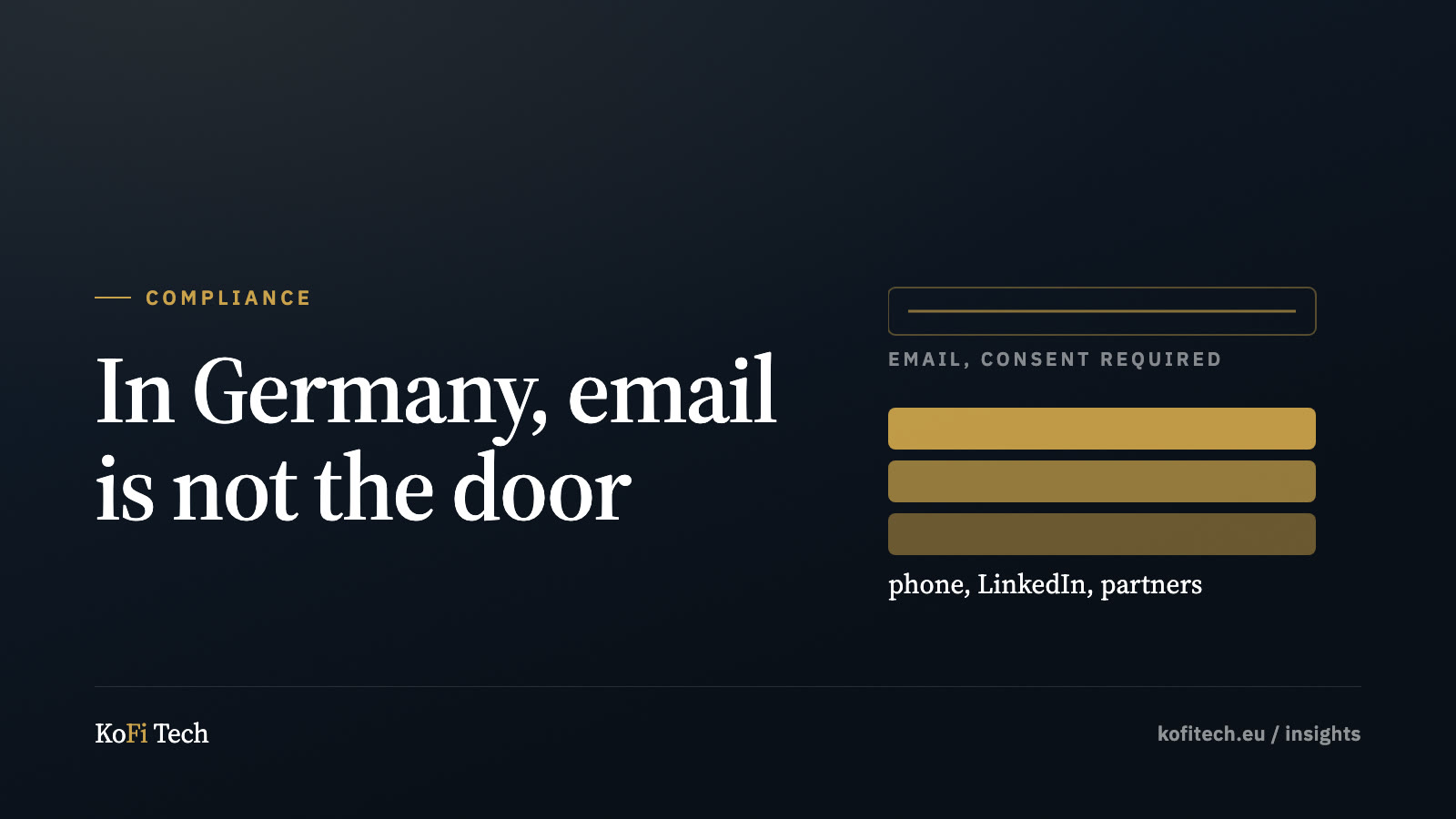
Cold email in Germany: why the GDPR is the easier half
German competition law treats unsolicited commercial email as an actionable nuisance, and it lets your competitors act on it. The channel that works there is not email.
-
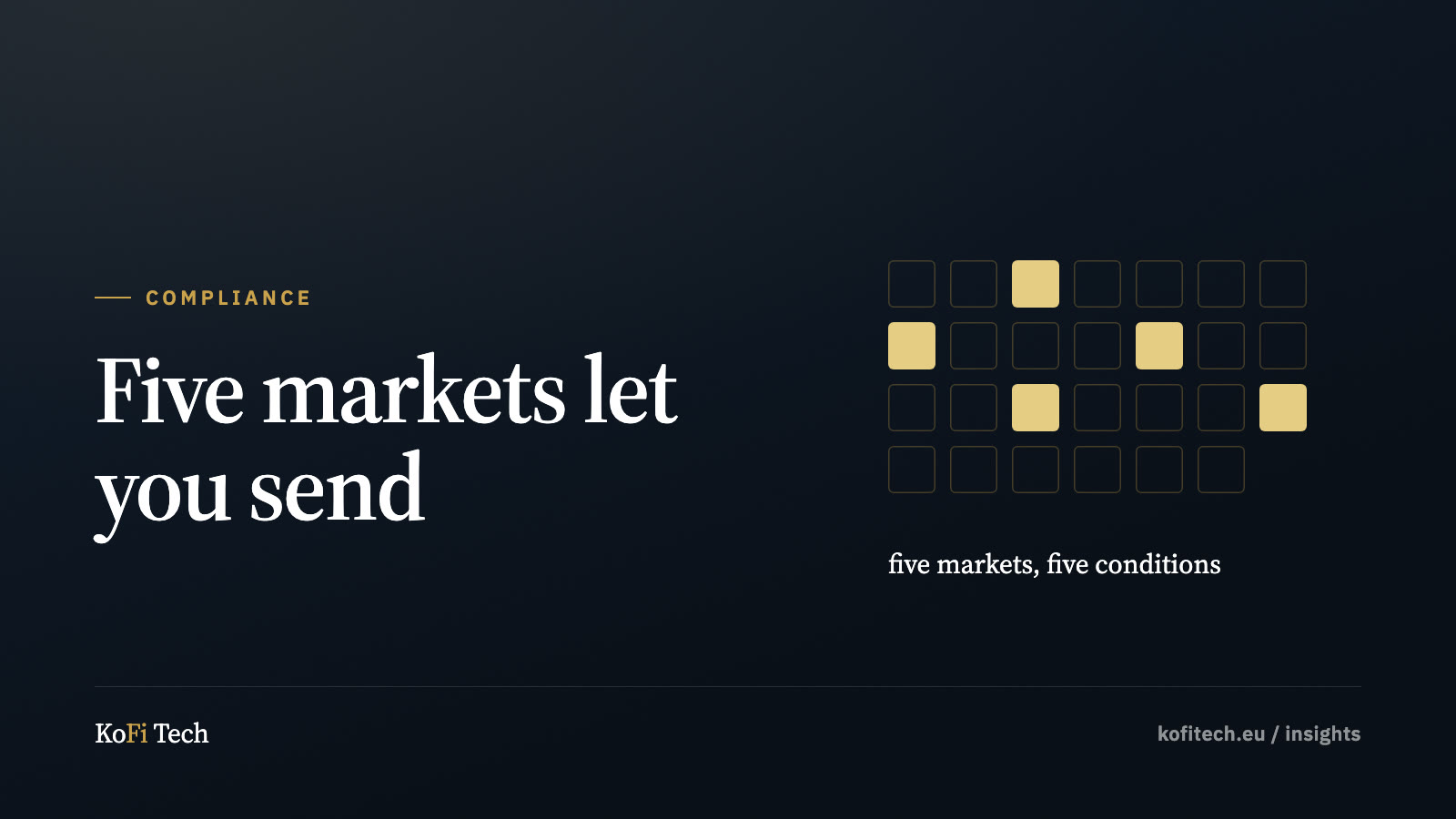
The five European markets where cold email is permitted, and their conditions
France, the Netherlands, Ireland, Belgium and the UK allow B2B email without prior consent. Each attaches conditions, and the French one catches senders who assume opt-out means anything goes.

