Translate the proof before you translate the website
The site goes into German, French or Polish before anyone has tested whether the offer deserves a local-language motion. Translation makes weak positioning sound fluent.

Founders expanding into Europe often translate too early. The website goes into German, French, Dutch or Polish before anyone has tested whether the offer deserves a local-language sales motion. The translation looks productive. It can also make weak positioning sound fluent in another language.
KoFi Tech treats localisation as a multiplier, not as a cure. It improves a message that already carries proof. It does not rescue a vague claim, a broad buyer definition or a service page that never names the problem. Before translating the website, translate the proof.
Proof is the part of the offer that still has weight after a buyer discounts your own claims. It can be a named customer, a public result, a sample deliverable, a workflow, a benchmark, a list of accounts found for the buyer, or a small pilot with a clear boundary. Without proof, local language makes the pitch easier to read and still easy to ignore.
Local language exposes weak proof
English hides a lot. Many European buyers read it as a second language, so vague English can pass through without feeling immediately wrong. Local language removes that buffer. A German buyer notices soft claims in German faster. A Polish founder notices filler in Polish faster. A French operations lead notices when the sentence sounds translated instead of native.
This is why translation should not start with the whole site. Start with the proof paragraph, the first email, the follow-up note and the meeting one-pager. If those cannot be made concrete in the buyer's language, the problem is not the translator.
A good localisation pass asks uncomfortable questions. Which result can we name? Which market does this example come from? Does the buyer recognise the category? Does the number mean anything in this country? Does the phrase describe a pain the local role actually feels?
Those questions improve the offer before they improve the language.
The website is rarely the first bottleneck
A polished local site helps once a buyer checks you. It confirms that the company is serious about the market. It answers basic objections. It supports procurement. It gives the sender a place to send people after the first conversation.
But most early market-entry failures happen before a buyer reads the site. The list is wrong. The timing is weak. The sender cannot explain why this account was chosen. The message makes a generic promise. The proof does not fit the buyer's sector. None of those failures gets fixed by a translated homepage.
A first local-language page should therefore be small. One offer page, one proof block, one contact route, one privacy notice if outreach points to it, and one clear next step. The rest can wait until replies show which market and buyer deserve depth.
There is no honour in translating twelve pages into a market that never replies.
Proof types ranked by strength
Not all proof carries the same weight. Buyers grade it quickly, even when they do not say so. The closer the proof sits to their own situation, the more useful it becomes.
| Proof type | Strength | What to check before translating |
|---|---|---|
| Named customer with permission | High | Buyer recognises the company or category |
| Sample deliverable | High | It looks like the work they would receive |
| Market-specific account sample | High | The accounts are real and visibly relevant |
| Quantified result | Medium | The baseline and source are clear |
| Founder credentials | Medium | They connect directly to the buyer's risk |
| Generic claim | Low | It should usually be deleted |
A market-specific account sample is underrated. For a company selling into Europe, showing ten well-chosen target accounts can create more trust than a broad capability page. It proves you have looked at the market, understand the buyer shape, and can start useful work before asking for a large commitment.
That is one reason Ripe Leads sits close to KoFi Tech's market-entry work. The first account sample becomes both sales material and market research. It gives the localisation team concrete language to work from.
Translate the buying situation first
Direct translation fails when it carries the wrong buying situation. A sentence written for a UK founder may not match a German Mittelstand department head. A page written for a Dutch English-speaking SaaS buyer may sound casual to a French regulated-sector buyer. The words change, but the deeper issue is context.
Before translating, rewrite the buying situation in plain terms. Who owns the problem in that country? What is their title? Which risk do they feel? Which internal argument must they win? What proof would they forward to a colleague?
Then translate that. The result is usually shorter than the original page. It names the buyer, the problem, the trigger and the proof. It avoids the borrowed global slogan that sounded fine in English and dead in the target market.
Use outreach to choose what deserves localisation
Localisation budgets should follow evidence. A launch team can test three markets with small native outreach slices before translating a full site. The replies show which terms buyers use, which objections repeat, and which proof blocks get forwarded.
That feedback is better than a style guide created in a meeting. Buyers hand you language when they object. They tell you the real competitor, the missing proof, the procurement blocker, and the phrase that sounds wrong. Capture it, then write the page.
The order is simple. Build a small account list. Write a tight first message in the buyer's language. Send at controlled volume. Read replies. Rewrite the offer page from what the market actually said. Then decide whether the full site deserves translation.
What KoFi Tech asks before localisation
Before a client localises, KoFi Tech asks four questions. Which buyer are we translating for? Which proof will they believe? Which channel will bring them to the page? Which decision should the page move them toward?
If the answers are weak, localisation waits. The money goes into account research, proof development and first conversations. When the answers are strong, localisation becomes easier and faster because the page has a job.
Ripe Leads makes this practical. It builds market-specific account samples, runs the outreach test, captures buyer language from replies, and shows which proof points earn meetings. KoFi Tech then uses that evidence to decide what to translate and how deep the market deserves to go.
Translate proof first. Translate the full site after the market has earned it.
The first translated asset should be used in outreach
The safest first localisation asset is not a full website. It is the short page a real prospect will see after receiving a message. That page should match the outreach angle exactly. Same buyer, same trigger, same proof, same ask. Anything else creates a break between the email and the site.
This page can be simple. It needs a clear headline, a proof block, a short explanation of the work, a named sender, legal business details, and a direct way to book or reply. For regulated or cross-border services, it should also carry enough company information for the buyer to verify who stands behind the message.
The page then becomes part of the test. If prospects click and do not reply, the proof may be weak or the ask may be too large. If they reply without clicking, the message may already carry enough context. If they forward the page internally, the wording on that page becomes more important than the homepage.
This is a better use of localisation money than translating every service page at once. It creates an asset the campaign can measure. It also gives the client a concrete piece of market language that can later become the full local site if the country earns it.
Proof must match the risk level
A small operational tool can lead with convenience and a quick sample. A cross-border advisory sale cannot. The buyer is risking time, internal credibility and sometimes compliance exposure. The proof has to match that risk.
For KoFi Tech work, that usually means showing the operating logic rather than a slogan. How the entity decision connects to the sales motion. How the account list was built. How reply data will change the market plan. How the founder avoids spending six months on a country that looked good only in a report.
For Ripe Leads work, it means showing the list logic and the campaign mechanics. Which accounts enter, why they enter, which trigger caused the contact, how the sender identity is handled, and how replies turn into meetings or market notes.
When proof matches risk, localisation has something solid to carry. Without that, the local copy becomes smoother, but the buyer still has no reason to trust the claim.
Use outreach data before localising the whole site
Ripe Leads is KoFi Tech's outbound arm. It tests account lists, messages and proof blocks in target markets so localisation money follows real buyer response.
Visit Ripe LeadsRead next
-
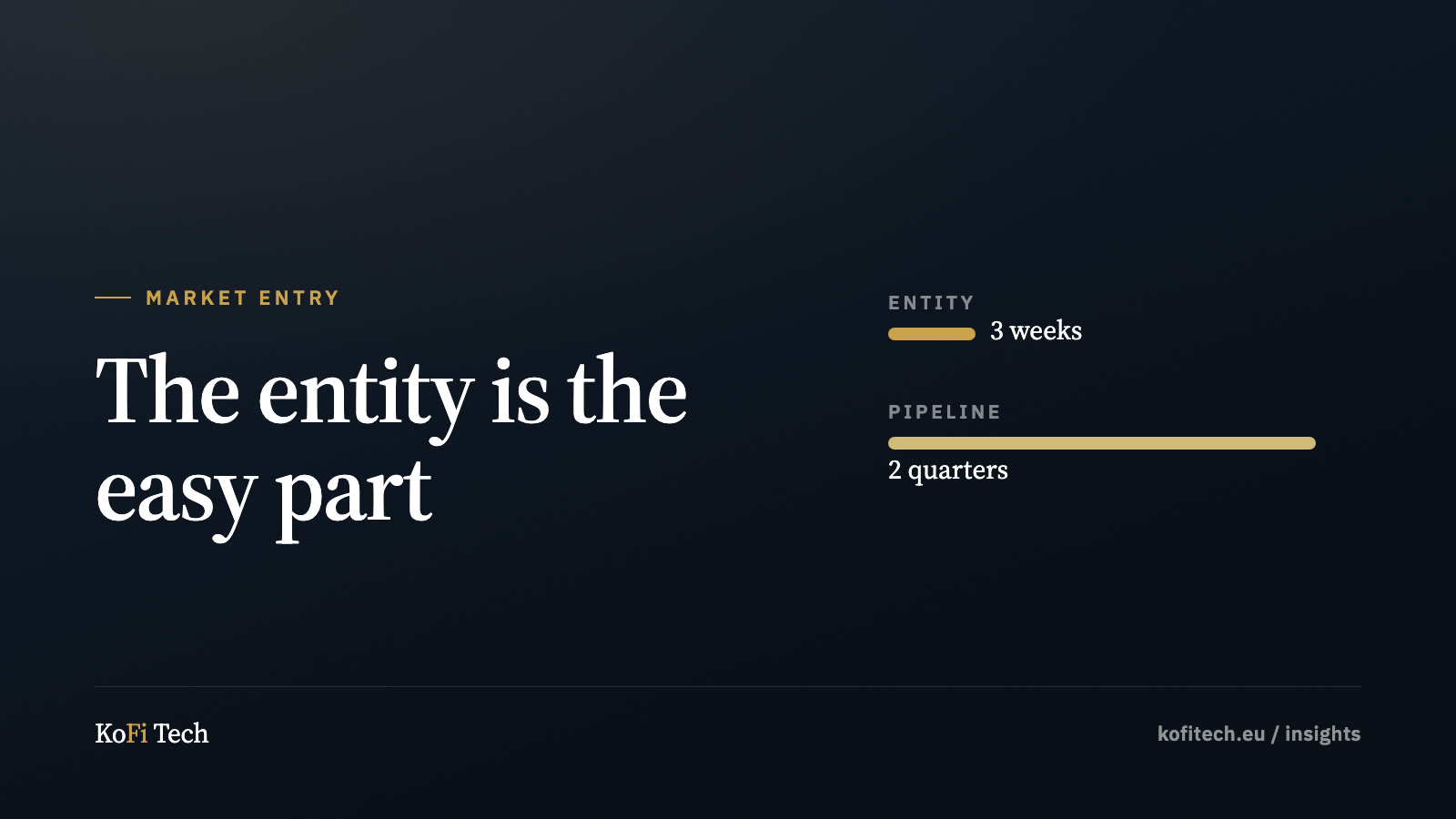
Your Lithuanian company will be ready in three weeks. Your pipeline will not.
Registering a UAB takes days of paperwork and about three weeks of waiting. Finding the first ten customers takes two quarters. Most expansion budgets are built the wrong way round.
-

Pick the signal before you pick the list
A hiring advert proves a company needs people. It says nothing about whether that company needs a supplier. Getting this backwards is the most expensive mistake in outbound.

